
AX Modernisation: It’s Not Just About Upgrading Code
Many food manufacturers view an AX modernisation project as simply upgrading the underlying code, hoping to inherit improved performance and access newer features; however, this approach often overlooks the fundamental opportunity to reimagine their operating model for a more efficient and responsive future. A true modernisation effort should focus on aligning processes, data, and technology to meet evolving business needs, rather than merely replicating existing inefficiencies in a new environment.
This article explores why many AX upgrades fall short of expectations and how Sysco Software’s approach helps food manufacturers achieve genuine transformation through Dynamics 365 Finance and Supply Chain Management.
Beyond the Code: The Real Goal of AX Modernisation
The technical aspects of an AX modernisation – the migration of code, data, and configurations – are undoubtedly important. Yet, they represent only a fraction of the overall effort required to realise the full potential of Microsoft Dynamics 365 Finance and Supply Chain Management.
The true goal lies in leveraging this opportunity to optimise business processes, enhance visibility across departments, and create a more agile and responsive organisation. For food manufacturers, this often means connecting traditionally siloed functions like finance, procurement, production planning, quality control, warehousing, EDI management, and shop-floor operations into a single, integrated platform.
This integration provides a holistic view of the business, enabling data-driven decision-making and improved operational efficiency.
The Pitfalls of “Lift and Shift”
A common approach to AX modernisation is often referred to as “lift and shift,” where existing customisations and processes are simply replicated in the new environment. While this may seem like a straightforward solution, it carries significant risks.
These include perpetuating inefficient workflows, hindering the adoption of best practices embedded within Dynamics 365 Finance and Supply Chain Management, and increasing complexity and maintenance costs. Furthermore, retaining outdated customisations can limit future flexibility and prevent organisations from fully leveraging the power of the Microsoft cloud platform.
Why Many AX Upgrades Miss the Mark
Numerous factors contribute to why many AX upgrades fail to deliver the expected benefits for food manufacturers. One primary reason is a lack of clear strategic objectives.
Without a well-defined vision for the future state, modernisation projects often become tactical exercises focused on addressing immediate pain points rather than driving long-term transformation. This can result in a fragmented implementation that fails to address underlying systemic issues.
Another common pitfall is inadequate stakeholder involvement. Successful AX modernisations require buy-in and collaboration from all departments impacted by the changes.
Failing to engage key stakeholders early and often can lead to resistance, delays, and ultimately, a less effective outcome.
The Challenge of Customisation
As mentioned previously, retaining excessive customisations is a significant impediment to successful modernisation. While some customisations may be necessary to accommodate unique business requirements, others are simply outdated or redundant.
A thorough assessment of existing customisations is crucial to identify those that can be eliminated or replaced with standard Dynamics 365 functionality. This requires a deep understanding of the underlying business processes and a willingness to challenge long-held assumptions.
Redefining Your Operating Model for Food Manufacturing
The food manufacturing industry faces unique challenges, including stringent regulatory requirements, complex supply chains, seasonal demand fluctuations, and a constant need to balance quality, safety, and efficiency. To thrive in this environment, food manufacturers must adopt an operating model that is agile, responsive, and data-driven. This requires breaking down silos between departments, streamlining processes, and leveraging technology to automate tasks and improve visibility.
The Importance of Batch Traceability
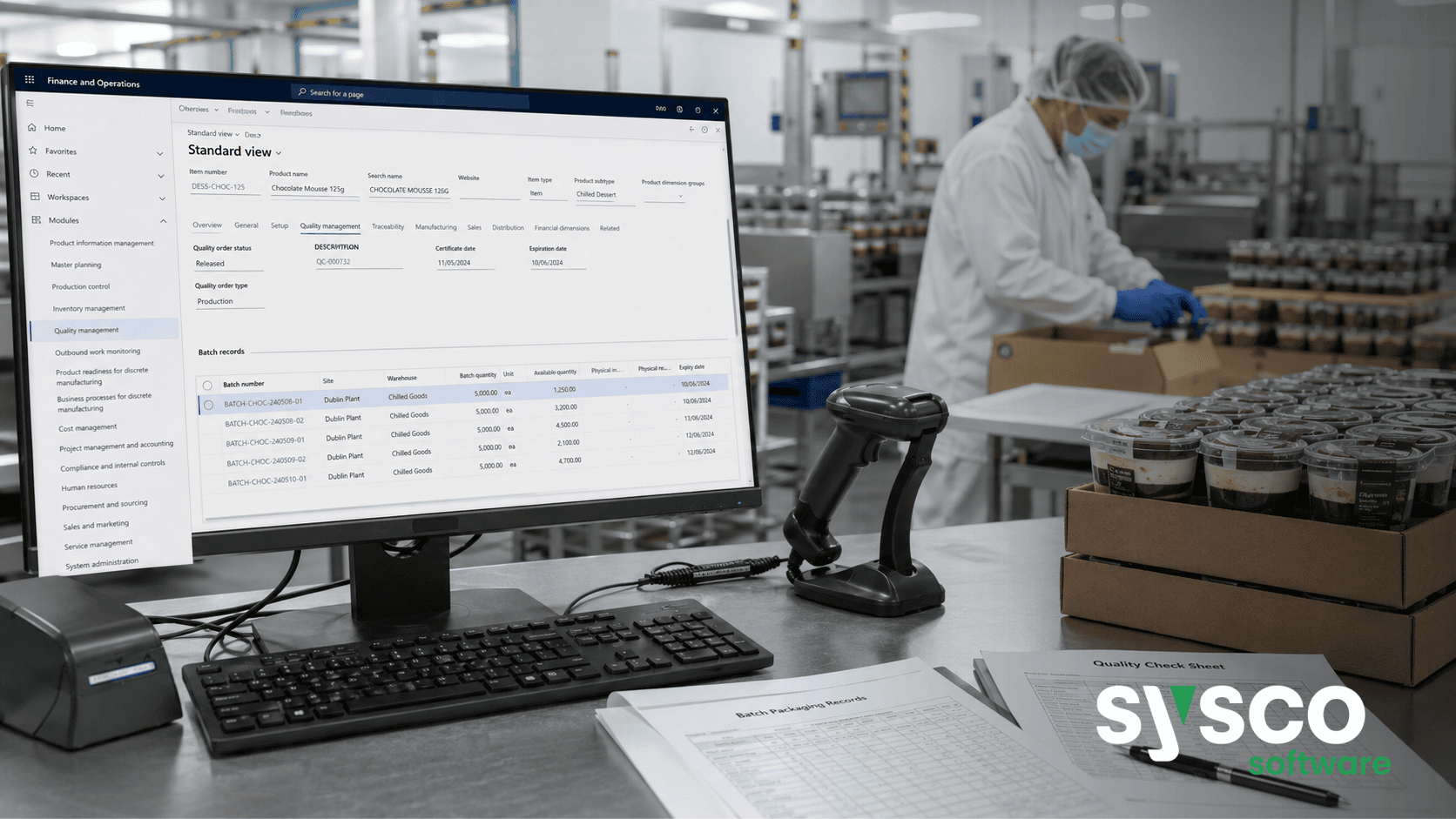
Batch traceability is paramount for food manufacturers, not only for regulatory compliance but also for maintaining product quality and safety. Dynamics 365 Finance and Supply Chain Management provides robust traceability capabilities that allow organisations to track ingredients, production processes, and distribution channels with granular detail. This level of visibility enables rapid response to recalls, reduces waste, and builds consumer trust.
Integrating Shop-Floor Data
Traditionally, shop-floor data has been isolated from enterprise systems, leading to delays in reporting and a lack of real-time insights. Sysco’s MES Data Collection App bridges this gap by connecting operator interactions on the factory floor directly to Dynamics 365 Finance and Supply Chain Management. This provides immediate visibility into production output, material consumption, labour usage, downtime, and scrap rates, enabling proactive decision-making and improved operational control.
The Role of Dynamics 365 Finance and Supply Chain Management
Dynamics 365 Finance and Supply Chain Management offers a comprehensive suite of capabilities specifically designed to address the needs of food manufacturers. From financial management and procurement to production planning and warehouse operations, this platform provides a single source of truth for all critical business processes. Its modular design allows organisations to implement only the functionality they need, while its scalability ensures it can grow with their evolving requirements.
Key Features for Food Manufacturers
Several key features within Dynamics 365 Finance and Supply Chain Management are particularly valuable for food manufacturers: financial dimensions for granular cost tracking, budgeting and forecasting tools for improved planning, production control modules for optimised manufacturing processes, inventory and warehousing management for efficient stock levels, and master planning capabilities for aligning supply and demand.
Furthermore, the Power BI integration provides powerful reporting and analytics to gain deeper insights into business performance.
Sysco’s Approach to Connected Food Manufacturing
Sysco Software’s approach to AX modernisation goes beyond simply migrating code; we focus on connecting finance, supply chain, and the factory floor through Dynamics 365 Finance and Supply Chain Management. Our methodology involves a thorough assessment of existing processes, identification of areas for improvement, and collaborative design of a future-state operating model.
We leverage our deep expertise in food manufacturing to guide organisations through this transformation, ensuring they realise the full potential of Microsoft’s technology.
The SmartStep Food Manufacturing Discovery
Sysco’s SmartStep Food Manufacturing Discovery workshops provide a structured approach to requirements gathering and platform fit assessment. These sessions bring together key stakeholders from across the organisation to define business objectives, identify pain points, and evaluate the suitability of Dynamics 365 Finance and Supply Chain Management for their specific needs. This collaborative process ensures that the modernisation project is aligned with strategic goals and delivers tangible results.
To learn more about how Sysco Software can help your food manufacturing business modernise Microsoft Dynamics AX and unlock the power of Dynamics 365 Finance and Supply Chain Management, visitSysco Software’s Dynamics 365 Finance and Supply Chain solutions page.






